
index
index Index Secretary-1 Secretary-2 Secretary-3 Secretary-4 Secretary-5 Secretary-6 Secretary-7 Secretary-8 Secretary-9

Secretarial Program


Page-6: Celestial

SwampMonster logo


Celestial and Cosmic Events


The Scheduler also looks up Cosmic Events. For example, Each SunSet and each SunRise.

SunRise

Here is the SunRise:
I get a notice 2 minutes prior to the SunRise, and a notice 1 minute prior.
Then the actual SunRise.
And one notice that is 1 minute after.

Mom's favorite flower was a yellow rose.
I am sure, it was forced to be a yellow rose, only because of the pressure of the question from the kids: "What is your favorite flower?"
I know this, because Mom traveled back to Arkansas, and returned with Purple Roses, which she was very proud of. They grew by her bedroom window. Every morning she could see them.


Then he began to call down curses, and he swore to them, "I don't know the man!" Immediately a rooster crowed.

"Truly I tell you," Jesus answered, "this very night, before the rooster crows, you will disown me three times."

Matthew 26:34, Matthew 26:74

The crow of a rooster gained a special significants in the Bible.
I know of many personally supernatural events, some large, some small.
Supernatural events surround us, bathe us, and endlessly occur every moment.
And the rooster fits the Natural setting of a SunRise, especially with our country home.
This Rooster was sent to me by my sister Becky. She said that she liked it, and did not know why.
So, I animated it, and included it. Thank you Becky.

My program technically knows very accurately the exact time of SunRise and SunSet. But I did not want to put Science in the highest esteem. I wanted to put the "magical" in the highest esteem and significants. Therefor, I had my AI Secretary use the rooster for supreme reference. In this example, she knows that it is SunRise, because of the Rooster Crow, not her clocks unparalleled in accuracy.


SunSet


SunSet is similar, except is played at full volume, because the secretaries assume that I am not asleep. However, long ago at KHSL, and Broadcasting in general, SunSet was very important for Legal reasons. It was the time, I think 30 minutes prior, that tower lights had to on. In addition all lights had to be visually verified, or remotely measured. I wrote the programs that measured the current from every side light bulb, and both beacon bulbs, for our two big towers.

Of course, my programs were serious back then. The were official, without the satire, drama, or sexual color. Nowadays, my programs are private and not so serious. But fun! My wife can not figure out how it could be "fun".


RULERMAR.GIF, 1 kB

Visual Moon Map


Moon Map
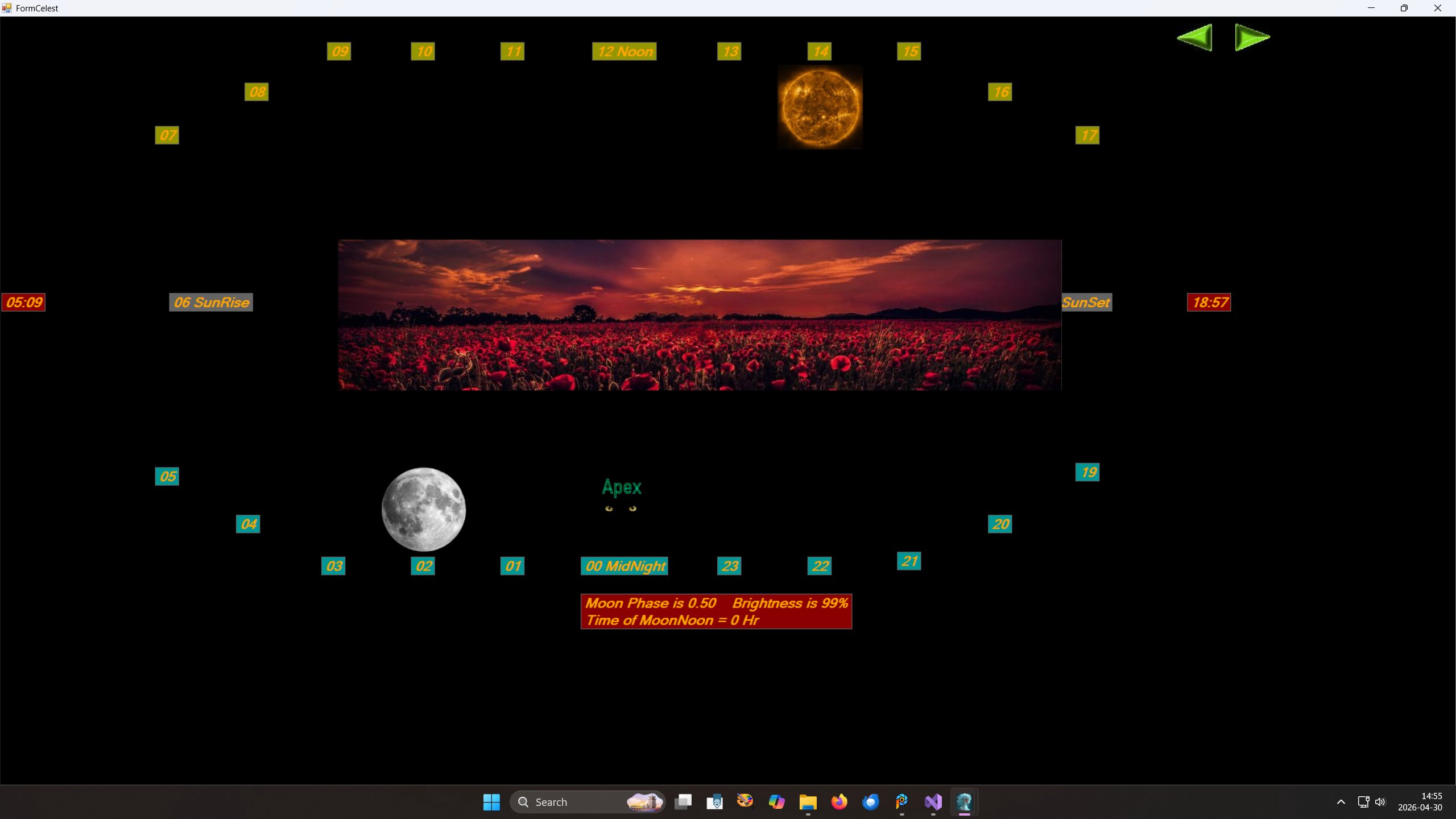
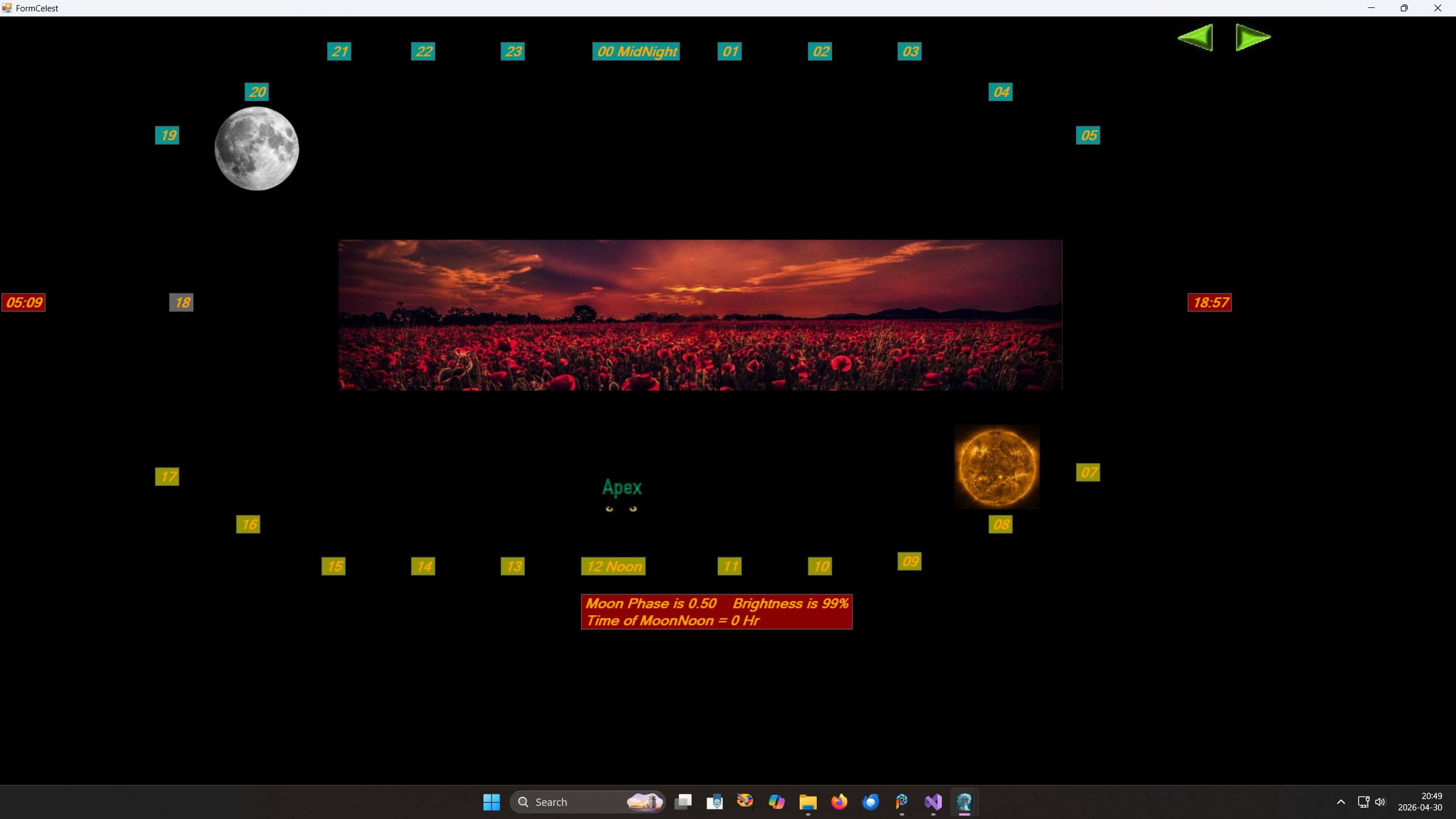
Here is a screen shot of a Celestial Screen. So far, it is only for the Moon. The moon is presently shown "under the Earth", and is not visible, at the 02:00 position. The phase is a "Full Moon", and the phase is known to several dismal places, but I have only created 8 moons depicting a moon in a particular view. The brightness is also know, and is listed as 99%. The hour of the "Apex", as I have it listed, is also known. In this case, the highest point in the sky is 00 hours, or "Midnight". Also note that for a Full Moon, the Sun is 180 degrees of the Moon, or 12 hours. With the Earth in between the Sun and the Moon, the Moon will be fully illuminated as viewed from anywhere on the Earth. And a New Moon is when the Moon is in front of the Sun, such that the sunlit side of the moon is not visible from the Earth. When the moon is out to the sides of the Earth in its orbit, only part of the sunlit side of the moon is visible.

I wrote this so that I would know where the moon is located in reference to a flat-looking Earth. Too make it easy and simple, I divided the "sky" into 24 parts, corresponding to Hours. I could have used 360 degrees, or of course two pi radians. But 24 hours works also by being intuitive. A 24 hour sky matches our biology. The precission is in the numbers, not in the illistrated positions. On an eleps, the position-numbers should bunch up at the apogee ends. Mine do not, out of laziness, I guess.


Moon Map
However, the 24 hour cycle is divided into two 12 hour sub cycles that represent day and night. From the perspective of a person standing on the surface of the earth, one witnesses two skys; a daytime sky and a nighttime sky. The label numbering changes, as well as the label coloring. On the one 24 hr map, any day begins near the "06" label. And any night begins near the "18" label. The labels change to keep a human standing upright and not upside down. Although, having a male brain, I can easily handle the mental gymnastics. Like being in a fighter jet or spacecraft. When I step out on the porch to look at the moon, I would rather have my "up" pointing up. Just saying...

How does it work? Of course, my secretaries have access to this information on the Internet, but they do not use or need it. I seed the program once a year. The accuracy of the lunar cycle is known to many decimal places. For example, 29.530588 days for the moon to circle the Earth, measured with Sun-facing reference. . I am also using the 27 day Star-cycle, which does not consider the moon's prograde with the earths rotation. And I suppose that I could seed, with initial conditions, once every twenty years if I wanted. But, there is a limit. Even with double precision, numbers begin to degrade with noise and uncertainty. It is like DNA replicating; you are going to get errors, and even more so in biology, in the real world of insults. But even in mathematics, with no external influence, fundamentally, as a pure principle, accuracy degrades; EVEN if you have telemiers and error correcting. No way around it; entropy wins, you can not even get a draw. Go look in the mirror.

There is entropy in the mirror as well as entropy of mathematical precision. I search for numerical ways to measure entropy. For example, every year there are more makeup bottles on the counter. My wife started out with a half dozen, now about 30. There is a corelation here, perhaps even a measurement. I dare not discuss physics type principles, like "Cant Win" with my wife. She might take away my computer.


Program_Screen_Celest.jpg, 439kB


Here, I have made more changes. I no longer use tables. My Remote Control MicroProcessor Chips still use tables. But here I have wrote Algorithms for all Sun and Moon Rise and Set times. The Secretaries already have this information and more, in cryptic tabulated form perfect for a digital agent. They do not need a picture of the moon and the sun. They live in a foreign world of numbers. But my human brain is more visual, and subjectively, this is just a quick depiction. A pictorial abstraction. A picture gives me a quick overview that is familiar to a human. The human brain is not capable of 4 or 5 digits of accuracy anyway. In evolution, there is no advantage to such a stupid need. But there is an advantage for speed and abstraction.

My Secretaries have no capabilities of analysing an image - far from it. But they love images when they are a gift to me. After all, they serve me. For example, my Nurse Secretary shows me actual pictures of my pill bottles, just to make sure I get it right. And now, I have a picture of the Solar System.

I do not use AI when I write. My code is my own, and if it is not natively in my head it does not get wrote. But, even now, ordinary people will be able to use AI to help with certain aspects of their lives, similar to this program.

And AI agents will be better at it than I. At least in high speed running of mechanical gears and gymnastics. In the mean time, I, out of breath, enjoy running along side a giant with wonderful promise. I may be clunkity and slow, and make mistakes. But for the present, I still have magical powers that clearly put me out ahead. I have to admitt that the leg-work has me out of breath, and I can not compete. But I have an advantage: I know where I am going.


RULERMAR
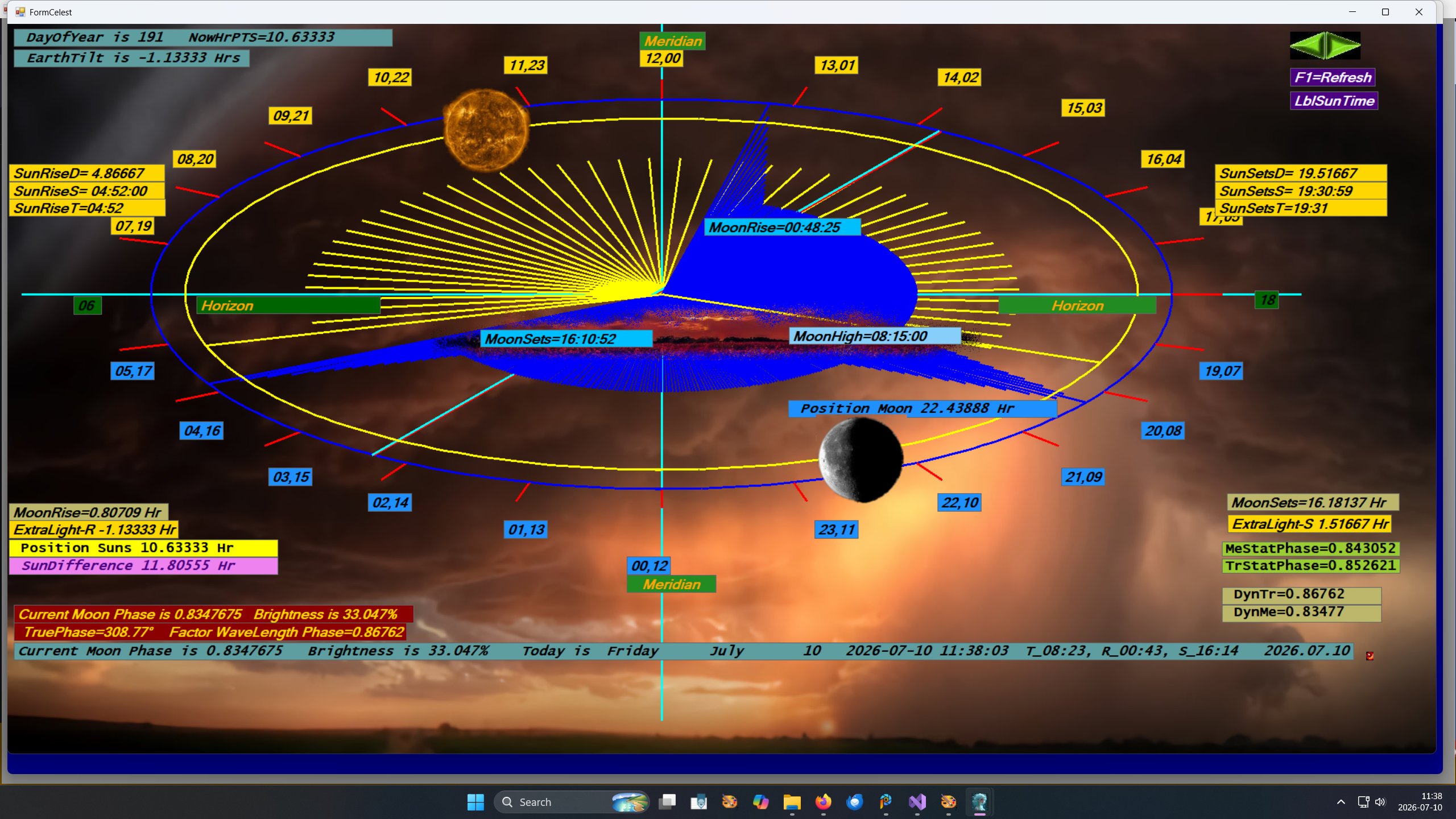
Prog_Celest_MoonSun.jpg, 390kB


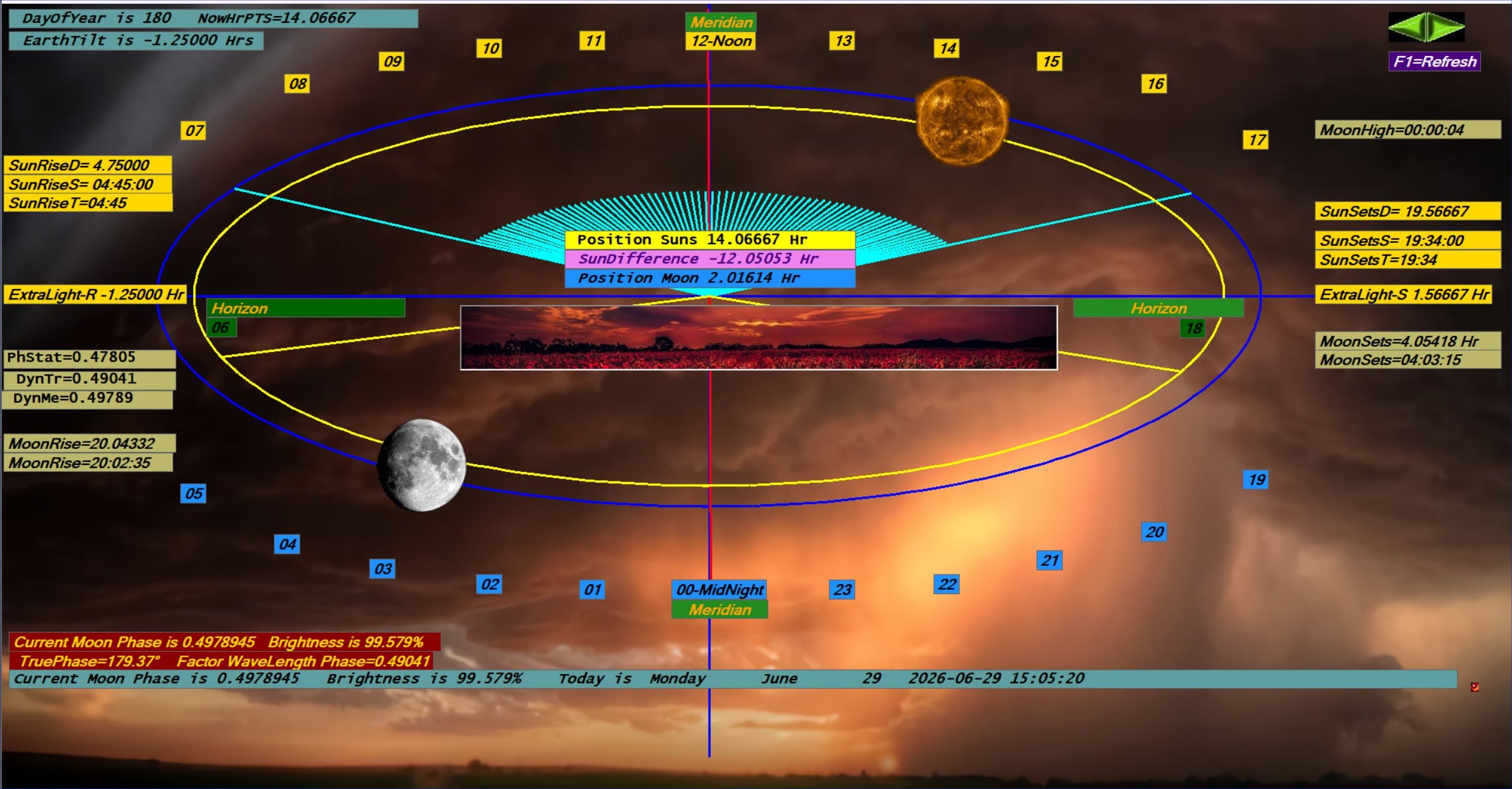
Now the program has a Moon-Meridian line. This line marks when the Moon is at its zeneth on either side of the Earth, Light or Dark. The equations for the Moon are complicated, and I have spent weeks on them. The equations can be simplified with the help of the Sun. For example, the tilt of the Earth is ridiculously simple. Just measure it using the Sun, and do not calculate it. The horizontal line represents the Earth at the equator, no Earth tilt, and runs through "6" and "18". Six and eighteen represent hours, but could also represent 180 degrees and 0 degrees. Sun up could be above or below the "6", and Sun Down could above or below the "18". For example, if SunUp is at 05:03, there is a difference of 6.000-5.050, or 0.95 Hours. You can actually use "Hours" to measure the tilt. Every one else uses degrees, as in Latitude. And the Earth's Tilt is basically the same for the Sun as for the Moon. Why make things difficult? Actually, the moon has a 5 degree difference in orbital plane, but it is small enough to egnore. This illeminates a lot of equations.


MoonScreen0710.jpg, 521kB


Made some changes.

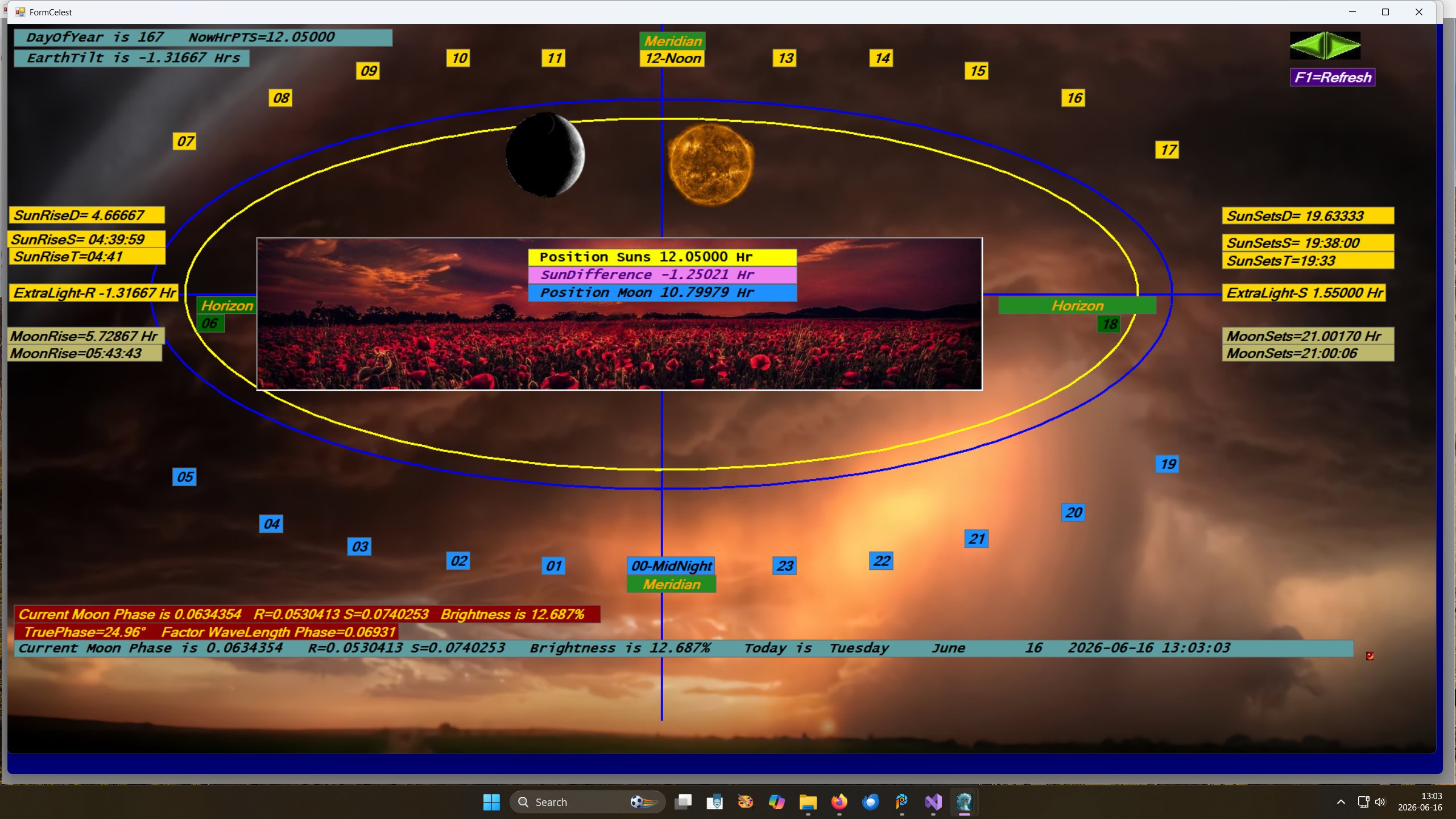
Added red tab markers for each hour. I am careful to maintain the concept of two 12 hour periods withen the 24 hour cycle. Our biological history dictates two skies. A 12 hour Day-Sky, and a 12 hour Night-Sky. But the 24 hour system is the only way to tell time. The 24 hour system is fundamental, and is the framework for all calculations. It does not matter on the units; the 24 hour system can be expressed in degrees, radians, or a fraction, as in a fundamental wave, 0 to 1. The 24 hour system is essential. But once the sun passes below the ground on the horizon for any given location, the sky changes to a NightTime sky. The letters change to a blue color and they change in enumeration to the 12 hour letters.

I am one of the first to build a hybrid clock that is both a 12 hour display and a 24 hour display. And of course it can only be done if you know the sunrise and the sunset times. The 12 hour system is about the sky. It can only be done if you can accurately simulate a real nighttime sky and a real daytime sky, as it looks to a real person, standing on the earth.

I would like to comment on the grey bar and the bottom. It contains the date and MoonRise and MoonSet times. This data came from the internet. So, I really do not need to write this "Moon" program. But no! I do need to write this program. Psychologically, I have to write it. I can not stand it if I do not write it. How long do we have to see Nature?

I would like to comment on the MoonRise and MoonSet forming "Wings" on the Moon-Sky; My Moon-Sky is the time when the moon is visible on Earth for this Latitude and Longitude. I am not too heavy in the calculations of the Earth's tilt. Instead, I use the Earth's tilt as already established by the sun. In the summer, the SunRise is before 6 am. And in the winter, the SunRise is after 6am. And in the summer, SunSet is after 18:00:00, and in the winter, before. The point is that one can draw an "Equatorial Line" between 06:00:00 and 18:00:00, and use it as a standard reference. Any deviations from this line represent the Earth's tilt. Not only that, but they automatically take into account the Latitude of the observer. The Latitude was already inputted for the suns calculations. Anyway, getting back to the wings or ears: Which are the MoonRise and the MoonSets. The center nose represents the Mid "ish" point, or Meridian, or Highest elevation. The wings always both work together in unison:

BBALLGRN.GIF, 138B They either point away from the Center-nose, as they do here, in the moon's first or fourth quarter. The ears are wide apart, and show a lot of hours for the moon in the sky. The moon's cycle is at or near zerro.

BBALLGRN.GIF, 138B or they lie flat, orthoganal to the Center-nose. Representing an equatorial orbit. No early or late MoonRise or MoonSet. The moon cycle is equatorial, and is 0.25 or 0.75, pi/2 or -pi/2, 90 degrees or 270 degrees.

BBALLGRN.GIF, 138B Or the wings point to the Center-Nose. Here there are little hours between MoonRise and MoonSet. The Moon is on the far side of the Earth, in the second or third quater. It is a full moon, and the moon rides low on the horizon. The moon's cycle is at or near 180 degrees, and the cosine of angles in the second and third quadrant are both negative. Which fold the wings toward the Center-Nose.

When the moon is in orbit around the earth on the "Suns-side", the wings behave the same as SunSet and SunRise. The Moon is setting and rising similar to the sun. But it is the opposite when the Moon is opposite the sun. Because on the opposite side, the tilt is opposite. In the summer, for my latitude in the northern hemisphere, the Earth tilts TOWARD the sun. And as the Moon rotates between the Earth and Sun, it too sees a tilt toward the sun. Almost, exactly like the sun, except a 5.1 degree difference. But as the Moon rotates around to the back side of the Moon, it sees the opposite. There, the Northern hemisphere is tilted AWAY from the moon. The Sun's wings cycle, once a year. Folded down in the summer, giving 3 extra day-hours. And folded up in the winter, giving 3 less hours. But the Moon's wings cycle way faster; every 29 days. Every 29 days, the moon has one down-cycle and one up-cycle.

I am glad that I devoted some time to the moon. Yesterday, I saw something that I never have seen before. My program girl announced that the moon was directly overhead. (My program does not calculate the zenith.) So, I went out to see, and could not see the moon at all. I was looking at the Meridian, basically due South. Just like before. When she has said it is the highest point, it has always been there. The sky was clear, no clouds. But then I saw it! I was shocked! Because I was looking too low. The moon was at the Meridian OK, but it was overhead, more or less straight up. Never before have I seen such a sight. The sight was actually slightly frightening. No, actually, quite alarming. Like the universe is ending, and the ending of all known laws of physics. ...Or; We are going to die. That is the feeling. I never expected it because, with the sun as my model, at this Latitude, the sun can not go straight overhead. I have only seen this one time. In Maui. Maui is 20 degrees Latitude, and expected near the summer solstice. Near noon, people walk around with no shadow. This Latitude of Chico is 39 degrees North, and at Solstice, the most earth tilt is 24 degrees. Not enough for the sun to be overhead. The moon has an additional 5 degree orbit above the ecliptic. Therefor, the most the Moon can do is 24 plus 5, or 29 degrees, and that is stretching it. Still not enough to be Directly overhead. But close. Dispite the frightning drama, objectively, all that can be said is, with no shadows to work with, the moon was simply very high in the sky. And I was scared of nothing. It is quite an art to scare yourself. ...and worth every bit of it!


Got to get rid of the piece of "Land" on the Horizon, because there is no "above-Horizon" or "below-horizon" on this map. There is an implied horizon for the sun at 6 and 18; But it is not true. This map is ONLY a representation of horizontal directions on the horizontal plane. Nothing to do with Zenith, or vertical elevation. Originally, my thinking was stupid.

Example:
At 08:15 the Moon was not only in the moon-sky, which is the sky-space between MoonRise and MoonSet, it was also at that frightening maximum elevation. It was NOT below the Horizon, as I originally designed! In fact, the moon was only a few degrees of zenith, almost straight up overhead. I would need a separate map to show elevation. I am so glad that I began this Moon investigations, as I have seen amazing and shocking revelations. The last time that I showed this amount of amazement at the moon was probably when I was 4 or 5. It is about time to revisit. Because it is stupid to think the file is closed, from an observation, when I was 4 or 5. In fact, the file is never closed on anything.


I asked Gemini...

BBALLPUR.GIF, 880BMe...
I am confused:
People say the moons transit Meridian, for the northern hemisphere, is always South, the same as the sun. One the contrary, I only see this happening at the quarter points in the moons cycle; a more neutral equatorial lunar orbit position. Otherwise, the Midpoint of Moon Rise and Moon Set is not exactly "South". Nor is the arithmetic midpoint exactly the High-Point. No symmetry between the Meridian and MoonRise and MoonSet! Someone is crazy. Hope it is not me. The primary determinant is the rotation of the Earth on its axis, which of course gives a general answer of "South". But during the moons cycle near 0 and 0.5, the inclination of the Earth shows up most, where all all bets are off. I appreciate the unbiased precision input of AI, instead of this stupid craziness.


BBALLBLU.GIF, 139BGemini:
You are definitely not crazy.
Your observations are accurate, and your frustration stems from a common oversimplification in amateur astronomy. The idea that the Moon always transits "due South" in the Northern Hemisphere is a generalization that only holds true for objects located exactly on the celestial equator. Because the Moon’s orbit is complex, it rarely follows that simple rule.

Why "All Bets Are Off"The Moon's path is defined by two primary "wobbles" that prevent it from being a simple mirror of the Sun:
Orbital Inclination (The 5.1° Tilt): The Moon does not orbit Earth along the ecliptic (the Sun's path); its orbit is tilted by about 5.1°. This means that at any given moment, the Moon can be up to 5.1° north or south of the Sun's ecliptic path.

The Variable Declination: The Sun’s declination changes on a predictable annual cycle (between ±23.5°). The Moon, however, completes its declination cycle every 27.3 days (the tropical month). Because the Moon’s orbital tilt adds to or subtracts from the Earth’s 23.5° axial tilt, its declination can swing between roughly ±18.3° and ±28.6° over an 18.6-year cycle.

Why the Midpoint is Not the High PointYou noted that the arithmetic midpoint of rise and set times does not always align with the "High Point" (transit). This is correct for two reasons:
The Moon's Proper Motion: Unlike the stars, which are "fixed," the Moon moves about 13° eastward along its orbit every day. This movement shifts its position relative to the local meridian.

The Horizon/Atmospheric Factor:
When you measure the midpoint of rise and set times, you are measuring a span across a curved horizon. If the Moon is at a high northern declination, its path across the sky is skewed. The time it takes to rise to its peak is often not symmetric with the time it takes to set from its peak because the "arc" it carves through the sky is not centered on the observer’s meridian in the way a fixed star's arc would be.


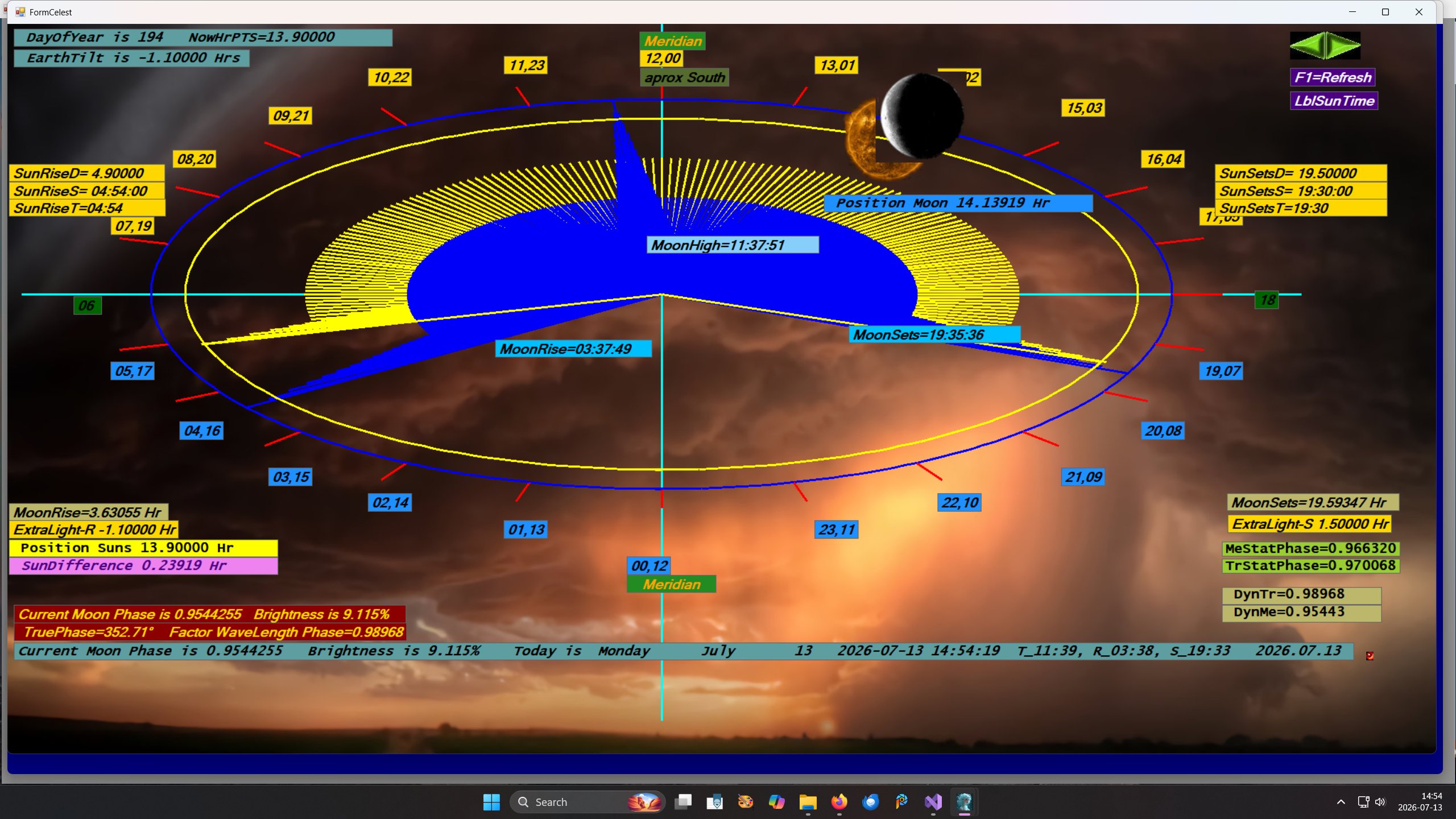
Screen_Moon0713.jpg, 499kB


Made some more changes...
Flipped the Moon, and the Moon display, 180 degrees, placing the moon near the sun, which is where it is. Now the mapping is strictly Horizontal. There is no hint that the Moon is high in the sky, almost 80 degrees elevation. And the Sun is lower down. The old mapping was a plane that vaguely represented the plane that contained the arc of the sun. It contained both a horizontal component as well as an elevation component. And necessarily contained a dark 12 hour period when the sun was "under" the horizon. And a light 12 hour period. It was a stupid idea. The old plane had advantages:
When a human looks at the sky for the sun, he only looks on a plane. Rises over there, and sets over there. That is where the sun lives. It has always lived there, whether your home is the North Pole or Equator; Its a plane. It is a familiar plane that you can trust.

Two advantages, for our ancestors:
One was brevity. It reduces the search area.
The other is Categorization. The human mind works on catagories. One is the plane.

Now I know that the Moon does not know the meaning of the word. Damn thing is complicated. The Old Plane needs to have its projection shown down, to establishing a new plane of pure Horizontal. The Old Plane contained two components. The vertical component of the Old Plane is the elevation angle in Polar CoOrdinates. On the New Plane's surface is a Clock, enumeration running Clockwise. And the start established dead bottom at MidNight. The Earth spins Counter Clockwise, and thus objects apear to rotate ClockWise around on this Clock. At a much slower rate, the Moon rotates around the Earth CounterClockwise. The moon progrades in the same direction as the Earth. So, every day the Moon rotates about 13 degrees from any marked Earth spot, CounterClockwise on my map. It is called the "Moon Cycle", and has a period of about 27 and 29 days. So very slowly, the Moon rotates CounterClockwise - from day to day. But rotates Clockwise from hour to hour, as the spinning Earth dominates the equation. Just because the Rotation Dominates, does not mean the prograde can be ignored hour to hour. It is still there and never rests, in the equations. That is easy to figure. Also the Earth is rotating around the Sun CounterClockwise, and appears to "prograde" from day to day. In one year, the moon system has gained 24 hours. But the gain is not liniar because the Earth Orbit is not circular. To say the least; I am happy to have aproximate times.
RULERBOW